US Bill Seal Colors: Red, Blue, Green, Brown, Yellow, Gold
The colored Treasury seal printed on the face of an American bill is the fastest way to tell what kind of note you are holding. Since the small notes of Series 1928, each class of US currency has worn its own color, and two wartime issues of 1942 borrowed a color of their own so they could be told apart at a glance.
Green: Federal Reserve Notes Blue: silver certificates Red: United States Notes Colors fixed from Series 1928
Last updated: November 2026
The seal color on a US bill identifies the type of note. On small-size notes green marks a Federal Reserve Note, blue a silver certificate, red a United States Note, yellow-gold a gold certificate and brown a National Bank Note or Federal Reserve Bank Note. Brown with HAWAII overprints, or yellow on a silver certificate, marks a 1942 wartime issue.
What does the seal color on a US bill mean?
It tells you the class of note, which in turn tells you what stood behind it. USPaperMoney.Info, a reference site on small-size notes, puts the rule simply: from the first small-size notes of Series 1928, the different types of currency were told apart by the color of their Treasury seals and serial numbers, while on the older large-size notes the colors carried no particular meaning (USPaperMoney.Info).
The seal itself is much older than the color code. The Treasury seal first appeared on currency during the Civil War, in 1862, and although its color and style have changed many times, the design inside it has stayed essentially the same: a key, a set of scales and stars (US Currency Education Program). On Federal Reserve Notes the wording around it changed with Series 1969, when the old Latin inscription gave way to an English one.
Read the color as a label, not a price tag. It narrows a note to one class, and the deeper page for each class, linked in the table below, takes it from there.
Which seal color goes with which type of note?
Five colors mark the small-size classes, with brown shared by two of them, and the Hawaii and North Africa emergency issues of the Second World War reused brown and yellow. The table lines each one up with its authority, its years and the denominations printed in small size.
| Seal color | Type of note | What backed or authorized it | Years issued in small size | Small-size denominations | Deeper page |
|---|---|---|---|---|---|
| Green | Federal Reserve Note | Federal Reserve Act of December 23, 1913; obligations of the United States, with collateral held by the Reserve Banks | Series 1928 to the present | $1 (from 1963), $2 (from 1976), $5 to $100; $500 to $10,000 until production ended by 1945 | Federal Reserve Notes |
| Blue | Silver certificate | Bland-Allison Act of February 28, 1878; silver deposited with the Treasury | Series 1928 to 1957B; none issued after 1965 | $1, $5, $10 | Silver certificates |
| Red | United States Note | Act of February 25, 1862; legal tender by law | Series 1928 to 1966A; last delivered 1971 | $1 (Series 1928 only), $2, $5, $100 (Series 1966 and 1966A) | Greenbacks |
| Yellow-gold | Gold certificate | Act of March 3, 1863; gold coin held by the Treasury | Series 1928 in circulation until 1933; Series 1934 for Treasury and Federal Reserve use only | $10 to $10,000 (1928); $100, $1,000, $10,000, $100,000 (1934) | Gold certificates |
| Brown | National Bank Note | Government bonds deposited by each national bank | Series 1929, last issued May 1935 | $5, $10, $20, $50, $100 | National Bank Notes |
| Brown | Federal Reserve Bank Note | Federal Reserve Act; obligation of the issuing Reserve Bank | Series 1929, issued 1933 and again in the Second World War; ended 1945 | $5, $10, $20, $50, $100 | US paper money history |
| Brown, HAWAII overprint | Hawaii emergency issue | Silver certificates and Federal Reserve Notes overprinted for the territory | August 1942 to 1944 | $1 silver certificate; $5, $10, $20 Federal Reserve Notes | Hawaii overprint notes |
| Yellow | North Africa emergency issue | Silver certificates with a yellow seal in place of blue | November 1942 to 1944 | $1, $5, $10 | WWII military currency |
Sources: BEP history fact sheets for Federal Reserve Notes, silver certificates, United States Notes, gold certificates, National Bank Notes, Federal Reserve Bank Notes and special and allied military currency; series and denominations from the USPaperMoney.Info checklist of small-size designs; North Africa denominations from Numismatic News.
What does a green seal mean?
A green seal means a Federal Reserve Note, the only kind of paper money the United States still issues. Every bill printed today has one, to the right of the portrait. The Bureau of Engraving and Printing records that green Treasury seals were overprinted on every denomination from the introduction of Series 1928, when the notes shrank to their present size, whereas the large-size Federal Reserve Notes of 1914 and 1918 had used red or blue seals (BEP fact sheet: Federal Reserve Notes).
That last point catches people out. A large blue-seal $500 or $10,000 note of Series 1918 is a Federal Reserve Note, not a silver certificate, because the color rule only begins in 1928. The green seal on a modern bill sits opposite a black seal, which stands for the Federal Reserve System; how the two seals, the bank letters and the series year fit together is covered in Federal Reserve Notes explained.
What is a blue seal dollar bill?
A blue seal dollar is a silver certificate. Congress created the class with the Bland-Allison Act of February 28, 1878, which let people deposit silver coin at the Treasury in return for paper certificates that were easier to carry than bags of dollars. As the government's silver stock shrank in the twentieth century, Congress decided in 1963 to end the certificates, redemption in silver stopped in 1968, and none have been issued since 1965 (BEP fact sheet: silver certificates).
Small-size silver certificates were printed in three values only, $1, $5 and $10. The $1 ran up to Series 1957B, the last silver certificate listed in the USPaperMoney.Info checklist, with the motto IN GOD WE TRUST on the back by then. That is the difference people mean when they ask how a silver certificate differs from a Federal Reserve Note: the certificate was a receipt for silver held by the Treasury, while a Federal Reserve Note is an obligation of the United States, and the Federal Reserve Banks must hold collateral, mostly government securities, equal to the notes they put into circulation (Federal Reserve Board). The Bureau still counts silver certificates as valid currency. Series, signatures and the scarce varieties are in our silver certificates guide.
What is a red seal $2 or $5 bill?
It is a United States Note, the class better known as the greenback or Legal Tender Note. Congress made them legal tender in an act dated February 25, 1862, and they stayed part of the money supply well into the twentieth century (BEP fact sheet: United States Notes). The Bureau's currency FAQ identifies them by their red seal and red serial number.
In small size the red seal is almost entirely a $2 and $5 story. The $2 ran from Series 1928 to 1963A and the $5 from Series 1928 to 1963, while the $1 appeared only in Series 1928 and the $100 only in Series 1966 and 1966A (USPaperMoney.Info). The ending was gradual. In 1966 the Treasury began taking the notes out of circulation and cut the series down to the $100 alone; the Bureau made its last delivery in 1971, none have been released since January 21, 1971, and the Riegle Community Development and Regulatory Improvement Act of 1994 ended the class for good. The full history is on our greenbacks page, and the $2 itself has a page at the $2 bill.
Are gold seal and yellow seal bills the same thing?
Not always. A small-size gold certificate of Series 1928 carries a seal that CoinWeek, describing the $10, calls yellow-gold, with serial numbers to match (CoinWeek); USPaperMoney.Info simply calls it yellow. Either way, the denomination gives it away: the Bureau's list of gold certificate values starts at $10.
Gold certificates go back to an act of March 3, 1863, and were at first certificates of deposit: gold went into the Treasury and paper came out. The banking crisis of 1933 took the country off the gold standard and the notes out of circulation (BEP fact sheet: gold certificates). A last Series 1934, in $100, $1,000, $10,000 and $100,000, was printed with orange backs and used only between Federal Reserve Banks.
A yellow seal on a $1, $5 or $10 note that says SILVER CERTIFICATE is something else: a North Africa emergency note, explained below. For the gold certificate story in depth, see the gold certificates guide.
What does a brown seal mean?
Brown covers three related things. On a Series 1929 note that names a bank, a town and a charter number, it marks a National Bank Note; on a Series 1929 note naming a Federal Reserve Bank, a Federal Reserve Bank Note; and on a note overprinted HAWAII, a wartime emergency issue. USPaperMoney.Info's key to small-size types assigns brown to National Currency and Federal Reserve Bank Notes together.
National Bank Notes and Federal Reserve Bank Notes
The small-size National Bank Notes of Series 1929 came in $5, $10, $20, $50 and $100 and were last issued in May 1935, when the Treasury retired the bonds that secured them (BEP fact sheet: National Bank Notes). Federal Reserve Bank Notes of the same series were made from existing National Bank Note blanks, overprinted for each Reserve Bank. They were issued during the bank closures of March 1933, the leftover stock was paid out during the Second World War, much of it in December 1942, and an act of June 12, 1945 ended the class (BEP fact sheet: Federal Reserve Bank Notes). Hometown collecting is covered on our National Bank Notes page.
Hawaii overprints
During the Second World War, with a Japanese invasion feared, the Treasury replaced regular currency in Hawaii with notes that could be singled out and declared valueless if enemy forces captured them. The issue combined two classes: the $1 was a silver certificate, while the $5, $10 and $20 were Federal Reserve Notes, and every one wore a brown seal, brown serial numbers and the word HAWAII on both sides. The Bureau dates their introduction to August 1942, their use in the territory to 1942 through 1944, and records 64,138,012 of them delivered (BEP fact sheet: special and allied military currency). Their full story, burning included, is on our Hawaii overprint notes page.
What are the yellow seal North Africa notes?
They are silver certificates printed with a yellow Treasury seal instead of the usual blue, made for American troops in the North African campaign. The Bureau's fact sheet says they were introduced in November 1942, used in North Africa until 1944, and carried into the Allied invasion of Sicily in July 1943 until Allied Military Lire were ready. The point of the color was the same as the Hawaii overprint: if the money were captured, it could be set apart and denied any value. The Bureau delivered 130,872,000 of them.
Numismatic News lists the denominations as $1, $5 and $10 (Numismatic News), and the USPaperMoney.Info checklist pins down the series: Series 1935A for the $1, 1934A for the $5, and both 1934 and 1934A for the $10. The wider family of wartime money, from Allied Military Currency to occupation yen, is on our WWII occupation and military currency page.
The brown HAWAII seal and the yellow North Africa seal were security markings. The Bureau says these special notes carried unique markings so they could be easily identified and refused as legal tender if large amounts fell into enemy hands.
Does the seal color tell you what a bill is worth?
No. The color tells you the class; the series, the condition, the signatures and the serial number decide the price. Blue seals show the spread best. CoinWeek reports that Series 1935 and 1957 silver certificates generally sell for less than $5 in circulated grades and up to a couple of hundred dollars in high grades, while the large 1899 eagle note, also a blue-seal silver certificate, ranges from roughly $100 for an average-condition common variety to more than $6,000 for the scarcest variety graded MS63 (CoinWeek).
Even the shade of a seal can matter at the top of the market. Reporting on a Heritage sale in October 2021, CoinWeek noted that a Series 1934 $5,000 Federal Reserve Note carried a blue-green seal, not the vivid light green expected on regular $5,000 and $10,000 notes, and suggested it was quite possibly a replacement note; it sold for $204,000 (CoinWeek). For the factors that do set value, start with star notes and replacement notes, and for the big notes themselves see $500, $1,000, $5,000 and $10,000 bills.
Planet Banknote is a family-owned dealership in Sarasota, Florida, led by a team with 15+ years in numismatics. Every note is sourced direct from mints, central banks, and authorized distributors, inspected through our Planet Banknote Verified process, and ships with a free Certificate of Authenticity. US orders ship free via USPS Priority, and every order includes a free bonus gift.
Frequently asked questions
What does a red seal on a $2 bill mean?
It means the bill is a United States Note, also called a Legal Tender Note, rather than a Federal Reserve Note. Small-size red seal $2 notes run from Series 1928 to 1963A. The Treasury began withdrawing United States Notes in 1966, and the Bureau of Engraving and Printing made its last delivery of them in 1971.
What is a blue seal dollar bill?
A silver certificate. The blue seal marks notes once backed by silver held at the Treasury, a class created by the Bland-Allison Act of 1878. Small-size silver certificates were printed in $1, $5 and $10 values. None have been issued since 1965, and they stopped being redeemable in silver in 1968.
What is the difference between a Federal Reserve Note and a silver certificate?
A silver certificate was a receipt for silver deposited with the Treasury and carries a blue seal. A Federal Reserve Note carries a green seal, is an obligation of the United States, and is backed by collateral, mainly government securities, that the Federal Reserve Banks must hold. Federal Reserve Notes are the only type still issued.
What does a yellow seal on a dollar bill mean?
On a $1, $5 or $10 silver certificate, a yellow seal marks a North Africa note, issued from November 1942 for American forces in North Africa and later Sicily, so the money could be cut off if captured. On a note headed GOLD CERTIFICATE, a yellow-gold seal simply marks a gold certificate.
What does a brown seal on a bill mean?
A brown seal appears on Series 1929 National Bank Notes and Federal Reserve Bank Notes, and on the 1942 Hawaii emergency notes. The Hawaii notes are easy to spot: HAWAII is printed on both sides. The set was a $1 silver certificate plus $5, $10 and $20 Federal Reserve Notes, used in the territory from 1942 to 1944.
Are blue seal and red seal bills still legal tender?
Yes. The Bureau of Engraving and Printing still treats silver certificates as valid currency, and government policy keeps every design of US currency legal tender. A silver certificate can no longer be exchanged for silver.
In our catalog
United States notes with green, red and brown seals in the Planet Banknote store.
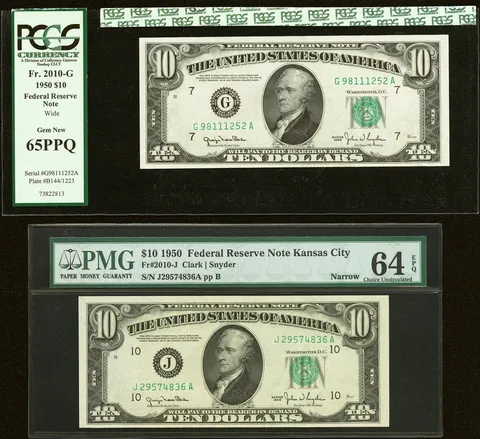 1950 $10 Federal Reserve Note Special Serial Number Set of 2 PCGS 65PPQ & PMG 64EPQSee current price →
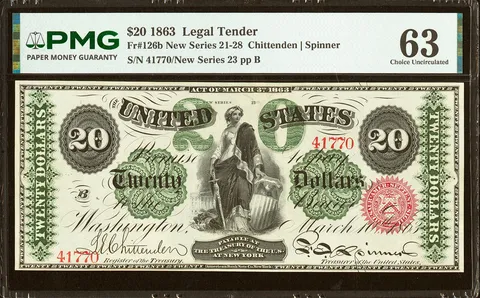 1863 $20 Legal Tender Note Fr.126b PMG 63CU Civil War Era Currency New SeriesSee current price →
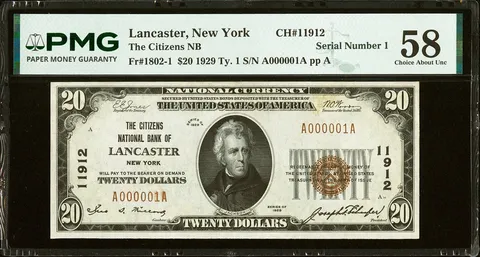 1929 $20 Lancaster NY The Citizens National Bank Ch. #11912 PMG 58 Serial Num 1See current price →