Argentina's 1989-90 Hyperinflation: The Austral
The austral was launched in June 1985 as the cure for Argentine inflation. Four years later it was the currency of a full hyperinflation, and its banknotes had climbed from a single austral to half a million. The Hanke-Krus World Hyperinflation Table dates the episode from May 1989 to March 1990, with prices rising 197 percent in the single month of July 1989 (Hanke and Krus, Cato Institute).
May 1989 to March 1990 197% in July 1989 Prices doubled every 19.4 days Top note: 500,000 australes
Last updated: November 2026
Argentina's hyperinflation ran from May 1989 to March 1990, according to the Hanke-Krus World Hyperinflation Table. Its worst month was July 1989, when consumer prices rose 197 percent, the same as prices doubling every 19.4 days. The currency that collapsed was the austral, introduced in 1985 and replaced by the peso on 1 January 1992.
What was Argentina's 1989-90 hyperinflation?
It was the moment Argentina's chronic inflation crossed the line into hyperinflation. Steve Hanke and Nicholas Krus, following the economist Phillip Cagan, count an episode from the first month in which prices rise at least 50 percent, and they end it only when the monthly rate falls below that mark and stays there for at least a year. By that rule Argentina's episode opened in May 1989 and closed in March 1990.
The definition matters because Argentina had lived with high inflation for years without meeting it. The Hanke-Krus table, published as a Cato Institute working paper, lists one Argentine episode, not several, and it attaches it to a single currency: the austral, measured with a consumer price index (Hanke and Krus, World Hyperinflations). That gives the austral a place in the same table as the Weimar papiermark and the Zimbabwe dollar, even though its peak was far lower. For the line between ordinary inflation and the runaway kind, see hyperinflation vs. inflation.
How high did Argentine inflation go?
At its worst, in July 1989, Argentine consumer prices rose 197 percent in one month. Hanke and Krus convert that to an equivalent daily rate of 3.69 percent and a price-doubling time of 19.4 days. All three figures describe the same month on different clocks: monthly, daily and doubling time.
A doubling time of under three weeks changes how people use money. At the July rate, prices roughly tripled within a single month. The months around the peak were also a social crisis: Ignacio Rossi of the Universidad Nacional de General Sarmiento records that looting spread through several cities and a state of siege followed (Rossi, RedNIE working paper 396).
What was the austral, and why did it fail?
The austral was the third new currency Argentina had adopted since 1970, after the peso ley of 1970 and the peso argentino of 1983. The central bank records that Decree 1096 of 14 June 1985 made the austral the national monetary unit from 15 June 1985, at one austral for 1,000 pesos argentinos (Banco Central de la República Argentina). It was the centerpiece of the Austral stabilization plan, launched by Economy Minister Juan Sourrouille in the government of President Raúl Alfonsín.
The plan bought time rather than stability. Rossi notes that annual inflation hovered around three digits, and that even with the Plan Austral prices still rose 90 percent in 1986. In 1988 the government tried again with the Plan Primavera, an adjustment program meant to bring inflation down before the 1989 elections. It drew on World Bank financing, aimed to cut the fiscal deficit from 6 to 2 percent of GDP, devalued the currency by 11 percent and set a temporary price agreement.
Under the program the central bank sold dollars to steer the exchange rate, and the loss of reserves became critical. Rossi records that the central bank had sold 1,800 million dollars of reserves between the launch of the plan and the end of February 1989, that dollar sales were suspended in February, and that a surprise 30 percent devaluation followed within a week of public assurances that the plan would continue. In his reading, hyperinflation arrived between April and May 1989, less than a year after the plan began.
What happened in 1989, month by month?
The austral's last stretch moved from a failed stabilization plan to a currency crisis, a change of economy minister, a state of siege and an early handover of the presidency, all inside six months. The table below dates each step from the central bank's records, Rossi's working paper and the Hanke-Krus table.
| Date | Event | Source |
|---|---|---|
| 14-15 June 1985 | Decree 1096 makes the austral the national currency, at 1 austral for 1,000 pesos argentinos | Banco Central de la República Argentina |
| 1988 | Plan Primavera launched to cut inflation before the 1989 elections | Rossi, RedNIE 396 |
| February 1989 | Central bank suspends dollar sales; a 30 percent devaluation | Rossi, RedNIE 396 |
| 30 March 1989 | The economic team resigns | Rossi, RedNIE 396 |
| 17 April 1989 | Government withdraws from the foreign exchange market | Rossi, RedNIE 396 |
| May 1989 | Hyperinflation episode begins | Hanke-Krus table |
| 29 May 1989 | State of siege declared after looting in several cities | Rossi, RedNIE 396 |
| 8 July 1989 | Early handover of power from Alfonsín to Carlos Menem | Rossi, RedNIE 396 |
| July 1989 | Peak month: consumer prices up 197 percent | Hanke-Krus table |
| March 1990 | Hyperinflation episode ends | Hanke-Krus table |
| 21 May 1990 | 100,000-austral note enters circulation | Banco Central de la República Argentina |
| 27 March 1991 | Convertibility Law 23.928 enacted | Banco Central de la República Argentina |
| 1 January 1992 | The peso replaces the austral at 1 peso for 10,000 australes | Banco Central de la República Argentina |
Episode dates and the peak rate follow the Hanke-Krus World Hyperinflation Table (Cato Institute). Monthly rate on a consumer price basis.
Which austral banknotes were issued?
The central bank lists 15 austral banknote issues across 12 denominations, from 1 austral in October 1985 to 500,000 australes in 1990. Three of the higher values first appeared as provisional notes: peso argentino notes stamped with their new value in australes, issued before the definitive austral designs were ready.
The dates in the central bank's table tell the story better than any chart. After the 100-austral note of November 1985, nothing larger appeared for more than two years. Then 500 australes arrived in May 1988 and 1,000 in September 1988. The year 1989 brought the 5,000-austral note in May and both versions of the 10,000 and the 50,000. The 100,000 followed in May 1990, and the 500,000 appeared that year in both forms.
| Denomination | Type | Issued | Legal tender until | Demonetized |
|---|---|---|---|---|
| 1 austral | Austral series | 31 Oct 1985 | 31 Oct 1991 | 31 Dec 1991 |
| 5 australes | Austral series | 28 Mar 1986 | 31 Oct 1991 | 31 Dec 1991 |
| 10 australes | Austral series | 30 Dec 1985 | 31 Oct 1991 | 31 Dec 1991 |
| 50 australes | Austral series | 23 Jun 1986 | 31 Dec 1991 | 1 Mar 1992 |
| 100 australes | Austral series | 25 Nov 1985 | 1 Jun 1992 | 30 Sep 1992 |
| 500 australes | Austral series | 2 May 1988 | 1 Jun 1992 | 30 Sep 1992 |
| 1,000 australes | Austral series | 30 Sep 1988 | 1 Jun 1992 | 30 Sep 1992 |
| 5,000 australes | Austral series | 26 May 1989 | 1 Oct 1992 | 31 Dec 1992 |
| 10,000 australes | Provisional stamped note | 31 Jul 1989 | 31 Aug 1991 | 31 Oct 1991 |
| 10,000 australes | Austral series | 25 Aug 1989 | 1 Oct 1992 | 31 Dec 1992 |
| 50,000 australes | Provisional stamped note | 2 Jun 1989 | 31 Aug 1991 | 31 Oct 1991 |
| 50,000 australes | Austral series | 8 Nov 1989 | 2 Jan 1993 | 31 Mar 1993 |
| 100,000 australes | Austral series | 21 May 1990 | 2 Jan 1993 | 31 Mar 1993 |
| 500,000 australes | Provisional stamped note | 2 Jul 1990 | 31 Oct 1991 | 31 Dec 1991 |
| 500,000 australes | Austral series | 1 Nov 1990 | 2 Jan 1993 | 15 Jan 1993 |
Dates from the central bank's list of previous issues (Banco Central de la República Argentina). "Provisional stamped note" is the bank's billete provisorio: a peso argentino note with a stamp stating its value in australes. For the 100, 500 and 1,000-austral notes, the bank extended the exchange period to 30 November 1992.
Coins tell the same story from below. The bank's coin list shows the smallest notes being pushed into metal as prices rose: a 1-austral coin on 27 March 1989, a 5-austral coin on 22 May 1989 and a 10-austral coin on 26 June 1989. By November 1990 there were coins of 100, 500 and 1,000 australes, so a value that had been a banknote in 1988 had become small change.
How does Argentina compare with other hyperinflations?
Argentina's episode belongs to a run of Latin American hyperinflations that the Hanke-Krus table dates between 1984 and 1991. In the Hanke-Krus table, Peru and Nicaragua peaked higher, Bolivia and Brazil lower. All five are dwarfed by Germany in 1923, the standard reference point for a collapsing currency.
| Episode | Start | End | Peak month | Peak monthly rate | Prices doubled every |
|---|---|---|---|---|---|
| Argentina (austral) | May 1989 | Mar 1990 | Jul 1989 | 197% | 19.4 days |
| Peru (inti) | Jul 1990 | Aug 1990 | Aug 1990 | 397% | 13.1 days |
| Nicaragua (córdoba) | Jun 1986 | Mar 1991 | Mar 1991 | 261% | 16.4 days |
| Bolivia (boliviano) | Apr 1984 | Sep 1985 | Feb 1985 | 183% | 20.3 days |
| Brazil (cruzado and cruzeiro) | Dec 1989 | Mar 1990 | Mar 1990 | 82.4% | 35.1 days |
| Germany (papiermark) | Aug 1922 | Dec 1923 | Oct 1923 | 29,500% | 3.70 days |
All rows from the Hanke-Krus World Hyperinflation Table (Cato Institute working paper). Rates are monthly. Germany's rate uses a wholesale price index; the others use consumer prices.
For the full list, ranked by peak month, see every hyperinflation ranked. Argentina's episode also overlapped with Brazil's: both ended in March 1990.
What replaced the austral?
The peso did, on 1 January 1992. The central bank records that Decree 2128 of 10 October 1991 brought the new peso line into force from that date, at one peso for 10,000 australes, and that the peso was convertible one for one with the US dollar under the Convertibility Law 23.928 of 27 March 1991. Early notes of the new line carried the words "Convertibles de curso legal".
Read together with the decree of 1985, the arithmetic is plain: one 1992 peso stood for 10,000 australes, and each austral had stood for 1,000 pesos argentinos. The austral therefore lasted six and a half years as a currency, and its notes stayed legal tender into the start of 1993: the last date in the central bank's table is the demonetization of the definitive 500,000-austral note on 15 January 1993. The longer chain of Argentine currencies is laid out on the Argentina banknotes hub and in our list of currency redenominations.
What should collectors look for in austral notes?
Start with the distinction the central bank itself draws: provisional and definitive. The 10,000, 50,000 and 500,000-austral values each exist as a stamped peso argentino note and as a definitive austral design. The provisional notes had short lives, with legal tender ending in 1991.
Second, look at the dates. The 1989 issues are the hyperinflation notes in the strict Hanke-Krus sense, and the 100,000 and 500,000-austral notes of 1990 are the top of the ladder. The low values date from 1985 and 1986, the first months of the austral, so a full run from 1 to 500,000 australes spans the whole life of the currency.
Third, treat every austral note as a collectible. The central bank states that all coins and notes of the austral line have been demonetized and can no longer be exchanged for current money. Our banknote grading guide explains the grades, and austral notes pair naturally with the other Latin American collapses in a hyperinflation set. For other money that has disappeared, see currencies that no longer exist and the companion museum page on Zaire's hyperinflation.
Planet Banknote is a family-owned dealership in Sarasota, Florida, led by a team with 15+ years in numismatics. Every note is sourced direct from mints, central banks, and authorized distributors, inspected through our Planet Banknote Verified process, and ships with a free Certificate of Authenticity. US orders ship free via USPS Priority, and every order includes a free bonus gift.
Frequently asked questions
When was Argentina's hyperinflation?
The Hanke-Krus World Hyperinflation Table dates Argentina's hyperinflation from May 1989 to March 1990. The episode starts with the first month in which prices rose at least 50 percent and ends once the monthly rate fell below 50 percent and stayed there for a year. The worst single month was July 1989, during the change of government from Raúl Alfonsín to Carlos Menem.
How bad was inflation in Argentina in 1989?
In July 1989 consumer prices rose 197 percent in one month, according to Hanke and Krus. That equals 3.69 percent a day, or prices doubling every 19.4 days. Ignacio Rossi's study of the period adds that looting spread through several cities and that a state of siege was declared on 29 May 1989.
What was the austral?
The austral was Argentina's currency from 15 June 1985, created by Decree 1096 at one austral for 1,000 pesos argentinos as part of the Plan Austral. It failed to end inflation, reached a 500,000-austral banknote in 1990, and was replaced by the peso on 1 January 1992 at one peso for 10,000 australes.
What was the highest austral banknote?
The highest was 500,000 australes. The central bank's records show it first as a provisional stamped peso argentino note issued on 2 July 1990, then as a definitive austral design issued on 1 November 1990. The definitive note was demonetized on 15 January 1993, after the peso had replaced the austral.
Can austral notes still be exchanged?
No. The Banco Central de la República Argentina states that every coin and banknote of the austral line has been demonetized and can no longer be exchanged for the current currency. The last austral note to lose its status was the definitive 500,000-austral note, demonetized on 15 January 1993.
How does Argentina's hyperinflation compare with Bolivia's and Peru's?
In the Hanke-Krus table, Argentina's peak of 197 percent a month in July 1989 is higher than Bolivia's 183 percent in February 1985 and lower than Peru's 397 percent in August 1990. Nicaragua peaked at 261 percent in March 1991 and Brazil at 82.4 percent in March 1990.
In our catalog
Argentine notes from the high-inflation years in the Planet Banknote store.
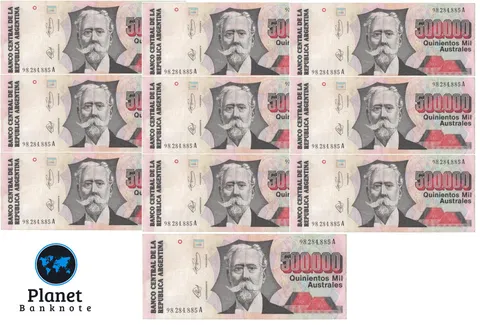 1991 Argentina 500,000 Australes/Peso Banknote Lot (10 pcs) P-338 Hyperinflation Era Circulated NotesSee current price →
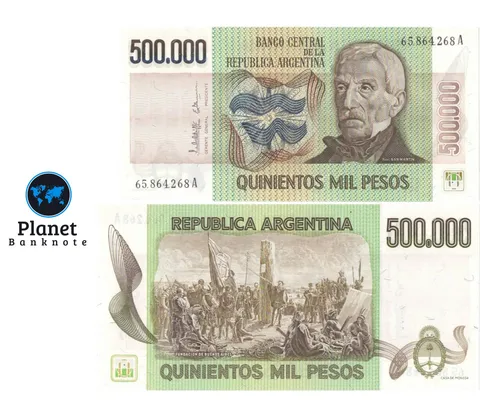 1979–1981 Argentina 500,000 Pesos Banknote P-308b San Martín UNC Crisp Hyperinflation EraSee current price →
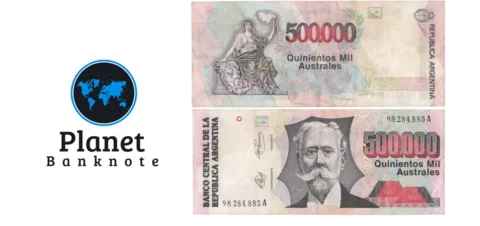 1991 Argentina 500,000 Australes Banknote Pack (100 pcs) P-338 Hyperinflation Era Circulated Lot $50,000,000 TOTALSee current price →
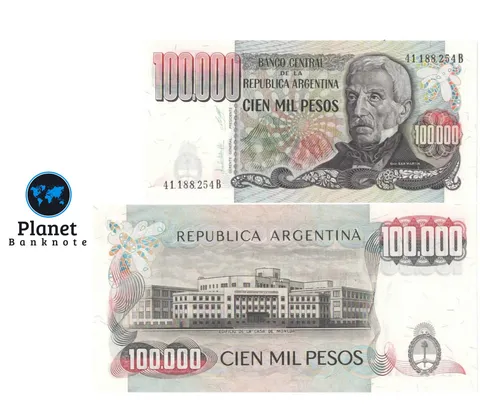 1979–1981 Argentina 100,000 Pesos Banknote P-308b San Martín UNC Crisp Hyperinflation EraSee current price →