Federal Reserve Notes Explained: Letters, Seals, Series
Every bill issued today is a Federal Reserve Note, and every one carries the same set of codes: a bank letter and number, two seals, a series year, a serial number, a position on the printing sheet and a pair of plate numbers. Learn where they sit and one note will tell you which Reserve Bank it came through, which design approval it belongs to and, in one case, which city printed it.
Authorized December 23, 1913 Twelve Reserve Banks, A to L Printed in Washington and Fort Worth The only US note type still issued
Last updated: November 2026
A Federal Reserve Note is the paper money the United States issues today, from $1 to $100. Authorized by the Federal Reserve Act of December 23, 1913, the notes are issued by the Federal Reserve Board through the twelve Reserve Banks, printed by the Bureau of Engraving and Printing, and coded to show the bank, the series and the plate.
What is a Federal Reserve Note?
It is the only kind of US paper money still being issued. The Board of Governors of the Federal Reserve System describes itself as the issuing authority for all Federal Reserve Notes, responsible for everything from keeping the supply adequate to guarding confidence in the currency (Federal Reserve Board). The Bureau of Engraving and Printing adds that the notes are issued through the regional Reserve Banks, which is why each one carries a district letter and number (BEP fact sheet: Federal Reserve Notes).
The legal footing goes back to the Federal Reserve Act of December 23, 1913. For their first two decades the notes could be redeemed in gold. That ended on January 30, 1934, when Congress amended Section 16 of the Act to declare the notes "obligations of the United States" payable in lawful money, and the Federal Reserve says redemption in silver ended in the 1960s as well. What stands behind them now is collateral: Congress requires each Reserve Bank to hold assets equal in value to the notes it puts into circulation, mostly Treasury, federal agency and government-sponsored enterprise securities (Federal Reserve Board).
Other classes of note fell away around them. National Bank Notes ended in 1935, silver certificates were last issued in 1965 and United States Notes last left the Bureau in 1971; how each one ended is traced in the history of US paper money, and how to tell them apart at a glance is on US bill seal colors.
What do the letters and numbers on a Federal Reserve Note mean?
They name the Federal Reserve Bank the note was issued through. There are twelve, lettered A to L and numbered 1 to 12 in the same order, from Boston to San Francisco. On the $5 to $100 the pair is printed under the left-hand serial number, and the letter also appears as the second letter of the serial; on the $1 and $2 the bank is shown in a seal instead (US Currency Education Program).
| Letter | Number | Reserve Bank city |
|---|---|---|
| A | 1 | Boston, Massachusetts |
| B | 2 | New York, New York |
| C | 3 | Philadelphia, Pennsylvania |
| D | 4 | Cleveland, Ohio |
| E | 5 | Richmond, Virginia |
| F | 6 | Atlanta, Georgia |
| G | 7 | Chicago, Illinois |
| H | 8 | St. Louis, Missouri |
| I | 9 | Minneapolis, Minnesota |
| J | 10 | Kansas City, Missouri |
| K | 11 | Dallas, Texas |
| L | 12 | San Francisco, California |
Codes from the US Currency Education Program; states from the BEP fact sheet on Federal Reserve Notes. The Federal Reserve itself identifies its districts by number and Reserve Bank city (Federal Reserve Board).
The code is about distribution, not geography of use. A note marked L12 can turn up anywhere in the country; the code only records the Reserve Bank that put it into circulation. The Federal Reserve's own district map has quirks a collector should know: the Seattle Branch of the 12th District serves Alaska, the San Francisco Bank serves Hawaii, Guam and American Samoa, and the New York Bank serves Puerto Rico and the US Virgin Islands.
What does each marking on the face of a bill tell you?
Seven printed markings carry information beyond the denomination. The table maps each to where it sits and what it records, using the US Currency Education Program's guide to banknote identifiers as the base.
| Marking | Where to find it | What it tells you |
|---|---|---|
| Serial number | Printed twice on the face | A unique combination of eleven letters and numbers; on the $5 and up, the first letter gives the series and the second the Reserve Bank |
| Federal Reserve indicator | Under the left serial number on the $5 to $100 | The issuing Reserve Bank as a letter and number, A1 to L12 |
| Black seal | Left of the portrait | On the $1 and $2, the name and letter of the issuing Reserve Bank; on the $5 to $100, the Federal Reserve System as a whole |
| Treasury seal | Right of the portrait, in green | The Department of the Treasury; English inscription from Series 1969 |
| Series year | On the face | The year a design was approved or a new Secretary or Treasurer signature was added; a capital letter after it marks a significant change |
| Note position letter and number | On the face, on the $2 to $100 | Where on the printing plate the note was printed; $1 notes from 50-subject sheets run from A1 to J5 |
| Face plate number | On the face; a small FW in front on Fort Worth notes | The printing plate used for the face, and the plant that printed the note |
The back carries an eighth code, the back plate number, which identifies the plate used for that side. Our page on fancy serial numbers covers the serials collectors pay extra for.
What do the two seals on a dollar bill mean?
The black seal on the left speaks for the Federal Reserve and the green seal on the right for the Treasury. On the $1 and $2 the black seal still bears the name and letter of the Reserve Bank that distributed the note; on the $5 to $100 it is a single design representing the whole Federal Reserve System, with the bank identified by the letter and number under the serial instead (US Currency Education Program).
That split dates from the 1990s redesign. USPaperMoney.Info records that on the Series 1996 $100 the black seal stopped showing the district letter and became one standard seal for the System, and that the lower denominations followed as they were redesigned (USPaperMoney.Info). The seal had changed before: on the first small-size notes it held the district number, which gave way to a letter during the Series 1928 run, at Series 1928B for the $5, $10 and $20 and Series 1928A for the $50 and $100 (USPaperMoney.Info).
The green Treasury seal changed in Series 1969, when its Latin inscription was replaced with "The Department of the Treasury, 1789" (BEP fact sheet). USPaperMoney.Info gives the old wording as "Thesaur. Amer. Septent. Sigil.", short for Thesauri Americae Septentrionalis Sigillum, and notes that it oddly translates as "The Seal of the Treasury of North America" (USPaperMoney.Info). What the seal colors meant on older classes of money is laid out on US bill seal colors.
What does the series year on a bill mean?
It is not the year the note was printed. The US Currency Education Program defines the series year as the year in which the Treasury Secretary signed off on a new design, or in which a newly appointed Secretary's or Treasurer's signature joined it; a capital letter after the year marks a significant change in the note's appearance (US Currency Education Program). USPaperMoney.Info makes the same point from the collector's side: the year in a series designation is not the year the bill was printed, so a Series 2017A note can come off the press years later.
The rule has shifted over time. USPaperMoney.Info explains that the series year originally marked the adoption of a design, with the letter advancing for minor changes such as a new signature, until 1974, when Treasury Secretary William E. Simon decided that each new Secretary would bring a new series year. Every Secretary since has followed that practice except G. William Miller, whose notes are Series 1977A rather than 1979 (USPaperMoney.Info).
The newest series is already on the Bureau's books. Its serial-number table now runs to the prefix letter R for Series 2025, listed for the $1, $5, $10, $20 and $100, with the signatures given as "Trump/Bessent" under a column headed "President/Treasurer" (Bureau of Engraving and Printing).
How do you read the serial number?
Each note has its own eleven-character serial number, printed twice on the face. On the $5 and higher the first letter gives the series, from A for Series 1996 to R for Series 2025 in the Bureau's table (Bureau of Engraving and Printing), and the second letter is the Reserve Bank; the $1 and $2 have no series letter. A star in place of the final letter marks a note printed to replace a faulty one during production (US Currency Education Program).
The Bureau of Engraving and Printing adds the rules that make serials readable: the letter O is never used because it looks like a zero, Z is held back for test printings, and the final letter moves on to the next one only once every eight-digit number has been used for that bank within that series (Bureau of Engraving and Printing). The full serial guide, including how to look a number up, is banknote serial numbers explained, and replacement notes have their own page at star notes.
Where and how are Federal Reserve Notes printed?
At two Bureau of Engraving and Printing plants, one in Washington, D.C. and one in Fort Worth, Texas. The Bureau describes itself as the nation's sole producer of paper currency, a role it has held for all US currency since 1877 (BEP history). The Fort Worth plant, the Western Currency Facility, began producing currency in 1990 as the first government facility outside Washington to print Federal Reserve notes (US Currency Education Program), and its notes carry a small FW before the face plate number.
The process builds a note in layers. Every denomination except the $1 and $2 starts with offset printing of its background colors. Then come the engraved intaglio plates: the backs are printed in green ink first and left to dry for three days, then the faces in black, followed by another three days of drying. A final letterpress run adds the two serial numbers, the black Federal Reserve seal, the green Treasury seal and the bank identifiers (BEP: how money is made).
The paper is part of the security. It is 75 percent cotton and 25 percent linen with red and blue fibers scattered through it (BEP: how money is made), and the Bureau's FAQ says a note can survive about 4,000 double folds before it tears and weighs about one gram whatever its denomination (BEP currency FAQs). Sheet sizes have grown over the decades: the 1929 change to small notes let the Bureau move from eight to twelve notes per sheet, and in February 2014 it began printing on 50-note sheets. More on presses and plates is in how banknotes are printed, and the Bureau's place among the world's currency printers in who prints the world's money.
How has the Federal Reserve Note changed since 1914?
Less than most people think. The Bureau's fact sheet says the look of the notes stayed largely the same for more than sixty years after Series 1928, until counterfeiting with copiers and printers forced a run of changes from Series 1990 onward. The milestones below come from that fact sheet and the US Currency Education Program.
| Series or year | Change |
|---|---|
| Series 1914 | First large-size notes, $5 to $100; the first $10 shows Andrew Jackson |
| Series 1918 | $500, $1,000, $5,000 and $10,000 added |
| Series 1928 | Small size of 6.14 by 2.61 inches; green Treasury seals on every denomination |
| Series 1934 | Notes no longer payable in gold; payable in "lawful money" |
| Series 1950 | Seals, signatures and district numbers overprinted; high denominations no longer issued |
| Series 1963 | $1 added as silver certificates are retired; IN GOD WE TRUST added |
| Series 1969 | Treasury seal with English inscription |
| Series 1976 | $2 added, in part to mark the bicentennial, with Trumbull's Declaration on the back |
| Series 1990 | Security thread and microprinting, first on the $100 |
| Series 1996 | Larger off-center portraits, watermark and color-shifting ink, starting with the $100 |
| Series 2004 | Background colors, starting with the $20 in 2003 |
| 2013 | Current $100, with the 3-D Security Ribbon, issued October 8 |
From the BEP fact sheet on Federal Reserve Notes, the BEP currency FAQs and the US Currency Education Program. The high denominations dropped from Series 1950 have their own story in $500, $1,000, $5,000 and $10,000 bills, and the faces on each value are listed in who is on each US bill. For the banks that issued notes before the Federal Reserve existed, see National Bank Notes.
Planet Banknote is a family-owned dealership in Sarasota, Florida, led by a team with 15+ years in numismatics. Every note is sourced direct from mints, central banks, and authorized distributors, inspected through our Planet Banknote Verified process, and ships with a free Certificate of Authenticity. US orders ship free via USPS Priority, and every order includes a free bonus gift.
Frequently asked questions
What does Federal Reserve Note mean on a dollar bill?
It names the type of money. Federal Reserve Notes are issued by the Board of Governors of the Federal Reserve System through the twelve Reserve Banks, under the Federal Reserve Act of 1913. They are the only US paper money issued today, and every current bill from the $1 to the $100 is one.
What do the letters on a dollar bill mean?
On the $5 to $100, the first letter of the serial number gives the series and the second names the issuing Federal Reserve Bank, from A for Boston to L for San Francisco; the same bank appears as a letter and number under the left serial. On the $1 and $2, the bank is shown in the black seal.
What is the difference between a Federal Reserve Note and a silver certificate?
The issuer and the backing. Silver certificates were Treasury receipts for silver, carried blue seals and were last issued in 1965. Federal Reserve Notes carry green Treasury seals, are obligations of the United States, and are backed by collateral the Reserve Banks must hold, mainly government securities.
Are Federal Reserve Notes backed by gold?
No. Gold redemption of Federal Reserve Notes ended on January 30, 1934, and silver redemption in the 1960s. Congress requires each Federal Reserve Bank to hold collateral equal in value to the notes it puts into circulation, chiefly Treasury, federal agency and government-sponsored enterprise securities.
What does the series year on a bill mean?
It marks the year the Treasury Secretary approved the note's design, or the year a new Secretary or Treasurer began signing it. It is not the printing date. A capital letter after the year, as in 2017A, marks a significant change to the note's appearance.
Where are dollar bills printed?
At the Bureau of Engraving and Printing's two plants, in Washington, D.C. and Fort Worth, Texas. The Fort Worth plant, the Western Currency Facility, began producing currency in 1990. Notes printed there carry a small FW just ahead of the face plate number, so you can tell which city printed a given bill.
Can a serial number tell you where a bill came from?
Partly. On the $5 and up, the second letter of the serial identifies the Federal Reserve Bank that issued the note, and the first letter identifies its series. A star at the end marks a replacement note. The serial does not show where the note has circulated since it was issued.
In our catalog
Planet Banknote store listings for notes covered on this page.
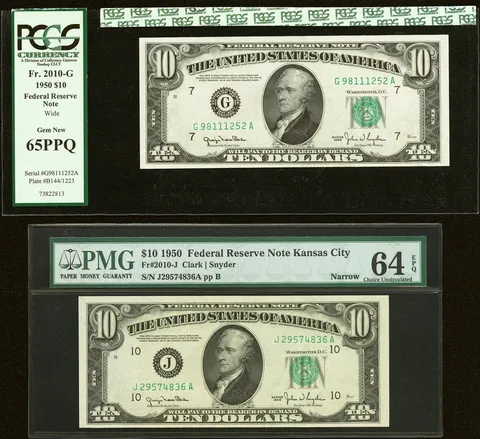 1950 $10 Federal Reserve Note Special Serial Number Set of 2 PCGS 65PPQ & PMG 64EPQSee current price →