Zaire's 1990s Hyperinflation: The Zaire and New Zaire
The Hanke-Krus World Hyperinflation Table carries three rows for the country: two under Zaire and one under the Democratic Republic of Congo. Its currency broke in 1991, was reissued as the new zaire in 1993, broke again within weeks, and was finally replaced by the Congolese franc in 1998. The worst single month was November 1993, when prices rose 250 percent (Hanke and Krus, Cato Institute).
Three Hanke-Krus episodes 250% in November 1993 1 new zaire = 3 million zaires Congolese franc back in 1998
Last updated: November 2026
Zaire went through two hyperinflations in the early 1990s and a third, briefer one in 1998. The Hanke-Krus table dates them October 1991 to September 1992, November 1993 to September 1994, and August 1998. The worst month was November 1993, at 250 percent, weeks after the new zaire replaced the old zaire at one for three million.
What caused Zaire's hyperinflation?
A political crisis that the government paid for with the printing press. In his 1997 IMF working paper, economist Philippe Beaugrand describes a long political crisis that drove government spending sharply higher, paid for almost wholly by creating new money, in a country without a market for government bonds (Beaugrand, Zaïre's Hyperinflation, 1990-96, IMF).
The sequence began on 24 April 1990, when President Mobutu announced a move to a multi-party system within twelve months. Demonstrations followed, and to calm them the authorities granted public-sector pay rises that came close to tripling the government wage bill by October 1990. Revenue moved the other way: payments from the main copper miner, Gécamines, fell, above all because a cave-in at its Kamoto site cut copper output. Beaugrand records that by late 1990 inflation and the depreciation of the currency had both passed 40 percent a month.
The national conference that was meant to manage the transition opened on 7 August 1991 with about 2,800 participants from 225 political groups. In September 1991 part of the army mutinied over pay, and looting spread across the country. Revenue collection halved in 1991, while broad money grew by 2,230 percent that year. For how this differs from ordinary high inflation, see hyperinflation vs. inflation.
How many hyperinflations did Zaire have?
Three, by the Hanke-Krus count. Two belong to the zaire and the new zaire in the early 1990s. The third is a single month, August 1998, after the Congolese franc had returned. Hanke and Krus note that they found that last episode in the IMF's International Financial Statistics database, where it had gone unnoticed by earlier studies.
| Episode | Start | End | Peak month | Peak monthly rate | Daily rate | Prices doubled every |
|---|---|---|---|---|---|---|
| Congo (Zaire), zaire | Oct 1991 | Sep 1992 | Nov 1991 | 114% | 2.57% | 27.7 days |
| Congo (Zaire), new zaire | Nov 1993 | Sep 1994 | Nov 1993 | 250% | 4.26% | 16.8 days |
| Democratic Republic of Congo, franc | Aug 1998 | Aug 1998 | Aug 1998 | 78.5% | 1.95% | 36.4 days |
From the Hanke-Krus World Hyperinflation Table (Cato Institute working paper), consumer price basis. Rates are monthly; the daily rate and doubling time are the table's own conversions of the same peak month. The table lists the currency for both 1990s rows as the zaïre.
The IMF figures match closely. Beaugrand gives 114 percent for November 1991, the same peak as the Hanke-Krus table, and about 250 percent for both November and December 1993, followed by 190 percent in January 1994. He adds that cumulative price increases over the three months ending in January 1994 exceeded 3,300 percent. Measured over a year, he writes, annual inflation reached a record 90,000 percent in the twelve months to September 1994, a rise in prices by a factor of 900 that beat the 640 recorded by Nicaragua in March 1991. See where those numbers rank on our list of every hyperinflation ranked.
What happened, year by year?
The zaire's collapse ran for most of a decade, with the worst of it packed into 1991 to 1994. The dates below come from the IMF study, the Banque Centrale du Congo and the Hanke-Krus table.
| Date | Event | Source |
|---|---|---|
| 24 June 1967 | The zaire replaces the Congolese franc in the first currency reform | Banque Centrale du Congo |
| 27 October 1971 | Country renamed Republic of Zaire; the central bank is renamed, first Banque Nationale du Zaïre, then Banque du Zaïre | Banque Centrale du Congo |
| 24 April 1990 | Mobutu announces a move to a multi-party system | IMF (Beaugrand) |
| September 1991 | Army mutiny and widespread looting | IMF (Beaugrand) |
| October 1991 | First hyperinflation episode begins | Hanke-Krus table |
| November 1991 | Peak month of the first episode: 114 percent | Hanke-Krus table; IMF |
| December 1992 | Bank of Zaire issues 5-million-zaire notes; most recipients refuse them | IMF (Beaugrand) |
| February 1993 | 10-million-zaire notes announced; a 15-ton shipment of 5-million notes is seized in Belgium | IMF (Beaugrand) |
| 28 September 1993 | New zaire replaces the zaire, according to the central bank's history | Banque Centrale du Congo |
| 22 October 1993 | Currency exchange carried out at 1 new zaire for 3 million zaires | IMF (Beaugrand) |
| November 1993 | Second episode begins and peaks at 250 percent | Hanke-Krus table |
| September 1994 | Second episode ends | Hanke-Krus table |
| April 1995 | Notes of 1,000 and 5,000 new zaires introduced | IMF (Beaugrand) |
| January 1996 | 10,000-new-zaire notes introduced | IMF (Beaugrand) |
| 17 May 1997 | Change of regime; the bank is renamed Banque Nationale du Congo, then Banque Centrale du Congo | Banque Centrale du Congo |
| 1998 | Congolese franc reintroduced | Banque Centrale du Congo |
| August 1998 | Third, one-month hyperinflation episode: 78.5 percent | Hanke-Krus table |
The central bank dates the new zaire to 28 September 1993; the IMF study dates the physical exchange of notes to 22 October 1993. Both are shown.
Why did Zaire print million-zaire notes?
Because inflation kept eroding the currency, and the new high notes of 1992 and 1993 met political resistance. Beaugrand records that the Bank of Zaire issued 5-million-zaire notes in December 1992 and that the Treasury tried to pay wages and salaries with them, but most recipients refused the new notes. Riots and looting followed in December 1992 and again in January 1993, with soldiers demonstrating over unpaid salaries.
In February 1993 the bank announced a 10-million-zaire note. In the same month a 15-ton shipment of 5-million-zaire notes was seized in Belgium at the request of Prime Minister Tshisekedi, whom Mobutu had tried to remove from office. For most of 1993, Beaugrand writes, Zaire had two prime ministers, two parliaments and no working government. The refusal to accept the new notes had a strange side effect: inflation slowed to about 13 percent a month from January to September 1993, because the Treasury could not spend money that people would not take.
What was the 1993 new zaire?
The new zaire was the country's second currency reform. The Banque Centrale du Congo dates it to 28 September 1993, when the zaire was replaced by the nouveau zaïre in the country's second monetary reform (Banque Centrale du Congo). The IMF study dates the exchange of notes to 22 October 1993, at one new zaire for three million old zaires.
It met resistance at once. The opposition boycotted the new notes, soldiers refused to accept them as pay, and rioting broke out again. In Western Kasaï province, Beaugrand notes, old zaires simply kept circulating as part of the boycott. Some 460 trillion old zaires, slightly more than a third of all currency issued, were never handed in for exchange. The month after the exchange, November 1993, became the worst month of the whole Zairian collapse in the Hanke-Krus table.
How high did the denominations climb?
The ladder shows two separate climbs. The old zaire reached a 5-million note, with a 10-million note announced, before the reform cut three million zaires down to one new zaire. The new zaire then started again from small notes and climbed into the thousands within three years.
| Denomination | Year | Unit | Note |
|---|---|---|---|
| 20, 50, 100, 500 and 1,000 | 1964 | Congolese franc | First notes of the Banque Nationale du Congo, 20 June 1964 |
| Zaire introduced | 1967 | Zaire | Replaces the Congolese franc on 24 June 1967 |
| 5 million | 1992 | Zaire | Issued December 1992; widely refused |
| 10 million | 1993 | Zaire | Announced February 1993 |
| 1 new zaire = 3 million zaires | 1993 | New zaire | Exchange carried out 22 October 1993 |
| 500 | 1995 | New zaire | Being issued early in 1995 |
| 1,000 and 5,000 | 1995 | New zaire | Introduced April 1995 |
| 10,000 | 1996 | New zaire | Introduced January 1996 |
| Congolese franc reintroduced | 1998 | Franc | Still the currency today |
Denominations and dates from Beaugrand (IMF, 1997) and the Banque Centrale du Congo.
The IMF paper also explains why the climb was slower than the inflation. The Bank of Zaire often delayed bringing in higher denominations, partly for fear of the political reaction it had met in 1992 and 1993. Instead it printed huge numbers of small notes: some 830 million new banknotes in 1995 alone, with an average face value below 2,000 new zaires.
How did the zaire end?
Slowly, then all at once. Inflation eased after 1994, to 370 percent in 1995, but rose again to 657 percent in 1996, leaving Zaire close to hyperinflation. The monthly rate jumped to 34 percent in January 1996 alone. The political end came with the change of regime on 17 May 1997, after which the central bank returned to the name Banque Nationale du Congo and then became the Banque Centrale du Congo (Banque Centrale du Congo, monetary history).
The central bank's own chronology lists the national currency in four stages: the Congolese franc inherited from the colonial period, the zaire introduced in 1967, the new zaire put into circulation in 1993, and the Congolese franc reintroduced in 1998 and still in use. Even the restored franc had a rough start: the Hanke-Krus table records a one-month hyperinflation of 78.5 percent in August 1998. The designs of the notes themselves are covered on the Zaire banknotes hub, and the other currencies that have vanished are collected in currencies that no longer exist.
What should collectors know about these notes?
First, separate the two currencies. A zaire note and a new zaire note can carry similar-looking numbers, but they belong to different units, three million to one apart. The 5-million-zaire note was issued in December 1992 and the 10-million note announced in February 1993, while the 1,000, 5,000 and 10,000-new-zaire notes followed in 1995 and 1996.
Second, the history of these notes is well documented. The IMF study records which denominations arrived when, which were refused, and that the bank moved to a less reputable foreign supplier in 1993-94 and went back to its traditional supplier in 1995. That makes it possible to build a set that follows the crisis month by month rather than just by face value.
Third, buy with condition in mind. Our banknote grading guide explains the grades, and Zaire notes sit well beside the Zimbabwe and Argentina collapses in a hyperinflation set. For the printers behind banknotes worldwide, see who prints the world's money, and for other reforms that cut zeros, our list of currency redenominations.
Planet Banknote is a family-owned dealership in Sarasota, Florida, led by a team with 15+ years in numismatics. Every note is sourced direct from mints, central banks, and authorized distributors, inspected through our Planet Banknote Verified process, and ships with a free Certificate of Authenticity. US orders ship free via USPS Priority, and every order includes a free bonus gift.
Frequently asked questions
Did Zaire have hyperinflation?
Yes. The Hanke-Krus table carries three rows for the country, two under Zaire and one under the Democratic Republic of Congo. The zaire collapsed between October 1991 and September 1992, with a peak month of 114 percent in November 1991. The new zaire's episode ran from November 1993 to September 1994, and its worst month, November 1993, saw prices rise 250 percent. The restored Congolese franc saw a one-month episode of 78.5 percent in August 1998.
What caused Zaire's hyperinflation?
An IMF study by Philippe Beaugrand traces it to a prolonged political crisis that led to a surge in government spending financed almost entirely by printing currency. Wage increases in 1990, falling copper revenue, an army mutiny in September 1991 and the standoff of 1993, when Zaire had two prime ministers, all deepened the crisis.
What was the new zaire?
The new zaire, or nouveau zaïre, replaced the zaire in 1993. The Banque Centrale du Congo dates the replacement to 28 September 1993, and the IMF records the exchange of notes on 22 October 1993 at one new zaire for three million zaires. The opposition boycotted it and the second hyperinflation began the next month.
What was the highest zaire banknote?
Among notes documented in the IMF study, the old zaire reached a 5-million-zaire note in December 1992 and a 10-million-zaire note announced in February 1993. After the 1993 reform the new zaire started again from small values and reached 10,000 new zaires by January 1996.
What currency replaced the zaire?
The Congolese franc. The Banque Centrale du Congo lists four stages of the national currency: the Congolese franc from the colonial period, the zaire from 1967, the new zaire from 1993, and the Congolese franc reintroduced in 1998, which is still in use. The bank itself took its current name after the change of regime on 17 May 1997.
How fast did prices double in Zaire?
At the November 1993 peak, prices doubled every 16.8 days, according to the Hanke-Krus table, which converts the 250 percent monthly rate into a daily rate of 4.26 percent. In the first episode the fastest doubling time was 27.7 days, in November 1991.
In our catalog
Zaire notes listed in the Planet Banknote store.
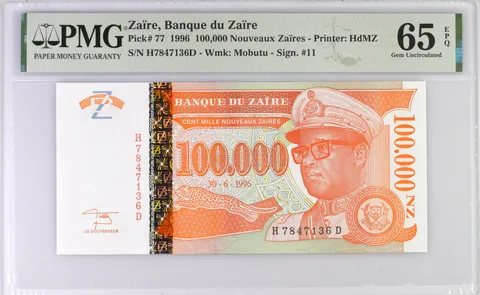 Zaïre 1996 100,000 Nouveaux Zaïres Pick 77 Mobutu PMG 65 EPQ Gem UncirculatedSee current price →