US National Bank Notes: America's Hometown Currency
For seven decades, more than fourteen thousand local banks issued paper money bearing their own name, their own town, and the signatures of their own officers. National Bank Notes turn American currency collecting into local history, one charter number at a time.
Last updated: August 2026
National Bank Notes were United States currency issued from 1863 to 1935 by individual, federally chartered banks, each note carrying the issuing bank's name, hometown, charter number, and officer signatures. Every note was secured by United States bonds the bank deposited with the Treasury, so the money was national in backing but local in identity. That combination is why collectors prize them today: a National Bank Note is the only US currency where the note itself tells you which bank in which town put it into circulation.
How did the national banking system work?
The system was born in the Civil War. President Lincoln signed the National Currency Act on 25 February 1863, and Congress substantially revised it as the National Bank Act in June 1864. The legislation created a new class of federally chartered "national banks," supervised by a new Treasury bureau, the Office of the Comptroller of the Currency, and charged with issuing a uniform national currency to replace the chaotic swirl of private state bank notes then in circulation.
The mechanics were elegant. A national bank purchased United States bonds and deposited them with the Treasury, and in return it could issue its own circulating notes up to 90 percent of the value of those bonds, as described by the Federal Reserve's history of the National Banking Acts. If the bank ever failed, the bonds stood behind its notes. To clear the field, Congress raised the tax on state bank notes to 10 percent in 1865; state note circulation collapsed from $143 million in 1865 to about $4 million by 1867 (Federal Reserve History). From then until 1935, hometown national currency was a fixture of American life.
What is a charter number, and why does it matter?
Every national bank received a charter number in the order it was organized, starting with Charter 1, granted to the First National Bank of Philadelphia in 1863. By the time the last charter went to the Roodhouse National Bank of Roodhouse, Illinois in December 1935, the count had reached 14,348, per the Society of Paper Money Collectors' national bank summary data. The charter number was printed on the bank's notes, which makes it the master key of the series: from a single number a collector can identify the bank, its town and state, roughly when it was chartered, and how scarce its surviving notes are.
Charter numbers also drive the collecting culture. Because each bank's notes are effectively their own mini-series, rarity is set bank by bank rather than design by design. Two notes of identical series, type, and grade can differ in price by a factor of a hundred simply because one came from a big-city bank that issued millions and the other from a small-town bank whose surviving notes number in the single digits.
What are the main types of National Bank Notes?
Catalogs divide the series into three charter periods of large-size notes plus the small-size Series of 1929, following the framework used by the Society of Paper Money Collectors' Bank Note History project.
| Type | Issued | What collectors look for |
|---|---|---|
| Original Series & Series of 1875 (First Charter) | 1863 to 1882 | Ornate allegorical vignettes; denominations ran from $1 to $1,000 |
| Series of 1882: Brown Back, Date Back, Value Back (Second Charter) | 1882 to 1908 (Brown Back), then transitional backs to circa 1922 | Brown Backs with the charter number woven into the back design; Date Backs show "1882 * 1908"; Value Backs spell the denomination across the back |
| Series of 1902: Red Seal, Date Back, Plain Back (Third Charter) | 1902 to 1929 | Red Seals are the scarce early printing; Plain Backs are the workhorse large-size type |
| Series of 1929, Type 1 | 1929 to May 1933 | Small-size notes, brown seal, charter number printed twice in black, serial numbers with a letter at each end (A000001A) |
| Series of 1929, Type 2 | May 1933 to 1935 | Charter number appears four times, the two extra printings in brown beside the serial numbers; shorter run, so generally scarcer |
How do I read a Series of 1929 note?
The Series of 1929 arrived when US currency shrank to its modern size, and it is the most accessible entry point into nationals. All 1929 nationals carry a brown Treasury seal and the bank's name and town printed in the same position a Federal Reserve district name occupies on today's notes. Denominations ran $5, $10, $20, $50, and $100.
Telling the two types apart takes seconds. On a Type 1 note, issued from 1929 into May 1933, the charter number appears twice in heavy black type, and the serial number is a letter, six digits, and a closing letter. On a Type 2 note, issued from May 1933 until the series ended in 1935, the charter number appears four times, with the two additional printings in brown ink placed right beside the serial numbers, and the serial drops the closing letter. Type 2 notes had a shorter run and are generally the scarcer of the pair for a given bank.
A worked example from our own inventory: a 1929 $5 note from Lakeland, Florida with serial B000003A reads as Type 1 at a glance, the A-suffix serial giving it away, and the 000003 tells you it was the third note of its kind the bank released. A 1929 $20 from The Citizens National Bank of Lancaster, New York, Charter 11912, with serial number 1, is the kind of piece bank presidents once pulled aside as a keepsake.
Why did National Bank Notes end in 1935?
The system did not fail; the collateral behind it was retired. In March 1935 President Roosevelt directed the Treasury to call the remaining United States bonds that carried the circulation privilege, and with those bonds gone, national banks lost the ability to secure new notes. Issuance wound down in 1935, and the notes were gradually redeemed out of circulation, as recounted in the Federal Reserve's 2026 history of American bank notes. Surviving notes were never demonetized: a National Bank Note remains legal tender and redeemable at face value, though virtually every survivor is worth far more to a collector than its face.
Why do collectors chase hometown notes?
Because no other US currency is local. A national from your town carries the name of a bank your great-grandparents may have walked into, signed by officers who lived down the street. Hometown collecting, building a set from one town, county, or state, is the emotional heart of the series, and it is why demand concentrates so unevenly: a common-bank note from a major city can be plentiful, while a small farm-town bank that issued briefly may be represented today by a handful of survivors.
Two premium layers sit on top of bank rarity. First, condition: an uncirculated small-town national is a different animal from a limp, pinholed one, and our banknote grading guide explains the scale that prices key off. Second, special serial numbers: officers of many banks saved the first sheet of their own currency as a souvenir, which is why serial number 1 nationals survive at all, and why they are chased so hard today; the grading service PMG calls serial 1 nationals some of the most fervently collected numbers in American paper money. Our fancy serial number guide covers the wider world of low and special serials.
How do I start collecting National Bank Notes?
- Start with the Series of 1929. Small-size nationals from larger banks are affordable in high grade, and the Type 1 versus Type 2 distinction gives the set structure from day one.
- Pick a place. Your home state, a family hometown, or a region you love. State rarity varies enormously, and part of the fun is learning which towns are sleepers. Our deep dive into the most valuable US banknotes shows where nationals sit in the wider market.
- Buy graded for scarcer banks. For common material, raw uncirculated notes are fine; for rare charters and serial number 1 pieces, third-party certification matters. Our PMG versus PCGS comparison explains the two services, and you can browse certified inventory in our graded banknotes collection.
- Learn the vocabulary. Charter periods, plain backs, brown seals: the banknote glossary keeps the jargon straight.
When you are ready to hunt, browse our United States banknote inventory, and for a deeper tour of rarity factors see our store-side guide to collecting nationals by charter number.
Frequently asked questions
What is a National Bank Note?
US currency issued from 1863 to 1935 by individual, federally chartered national banks under the National Banking Acts. Each note carries the issuing bank's name, town, charter number, and officer signatures, and was secured by United States bonds the bank deposited with the Treasury.
Are National Bank Notes still legal tender?
Yes. National Bank Notes were retired from circulation after 1935 but never demonetized, so they remain legal tender redeemable at face value. In practice, collector value exceeds face value for virtually every surviving note, so none are redeemed.
What is the difference between Type 1 and Type 2 1929 nationals?
Type 1 notes, issued from 1929 to May 1933, show the charter number twice in black and use serial numbers with a letter at each end, such as A000001A. Type 2 notes, issued from May 1933 to 1935, add two more charter number printings in brown ink beside the serial numbers and drop the closing serial letter. Type 2 had a shorter run and is generally scarcer.
What does the charter number on a national tell me?
Charter numbers were assigned sequentially from 1 (First National Bank of Philadelphia, 1863) to 14,348 (Roodhouse National Bank of Roodhouse, Illinois, December 1935), per Society of Paper Money Collectors summary data. The number identifies the exact issuing bank, its location, its approximate charter date, and, through census data, how many of its notes survive.
What makes one National Bank Note worth more than another?
Bank rarity comes first: notes are priced by how scarce the issuing bank's surviving notes are, so small-town banks with tiny issues command large premiums. Condition, charter period, state, and special serial numbers, especially serial number 1 notes saved by bank officers, layer further premiums on top.
Planet Banknote is a family-owned dealership in Sarasota, Florida, founded in 2021. Every note is sourced direct from mints, central banks, and authorized distributors, inspected through our Planet Banknote Verified process, and ships with a free Certificate of Authenticity. US orders ship free via USPS Priority, and every order includes a free bonus gift.
In our catalog
Planet Banknote store listings for notes covered on this page.
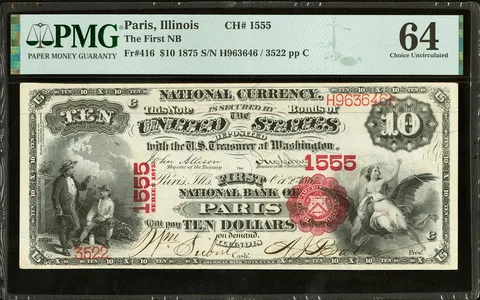 1875 Paris IL $10 National Currency Fr.416 The First National Bank CH#1555 PMG 64 Choice UncirculatedSee current price →
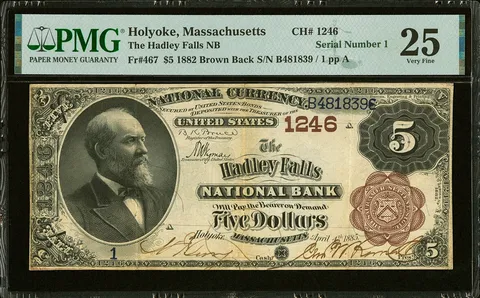 1882 UNITED STATES Holyoke MA $5 Brown Back National Currency Fr.467 Hadley Falls NB CH#1246 PMG VF25 SERIAL #1See current price →
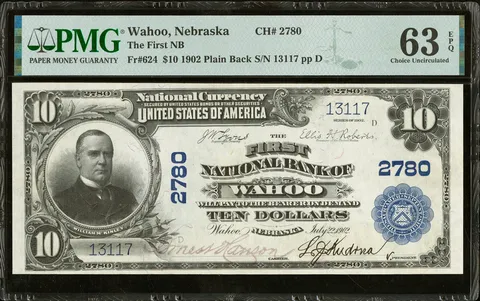 1902 Wahoo Nebraska $10 National Bank Note Fr 624 Ch 2780 PMG 63 EPQ McKinley Plain BackSee current price →
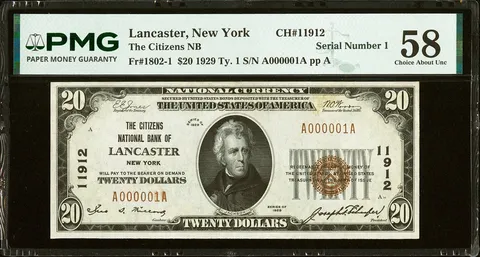 1929 $20 Lancaster NY The Citizens National Bank Ch. #11912 PMG 58 Serial Num 1See current price →