Obsolete Bank Notes: Wildcat Banks and Broken Bank Bills
For much of the time between the Revolution and the Civil War, the paper money in an American's pocket came from a bank down the street, or from one three states away that he had never heard of. Each bank printed its own notes, a printed reporter told you what they were worth, and the counterfeiters kept pace. Collectors now call these bills obsolete bank notes. Here is how the system worked, why it got its wild reputation, and how Congress ended it.
Issued 1782 to 1866 Free Banking Era 1837 to 1863 Ended by a 10 percent tax
Last updated: November 2026
Obsolete bank notes are the paper money that state-chartered and private banks issued in their own names before national currency took over, from 1782 to 1866. Each bank's notes were its own promise to pay in gold or silver coin. A federal tax of 10 percent on state bank notes, effective August 1, 1866, ended the system.
What are obsolete bank notes?
They are the notes that banks chartered by the states issued in their own names, each one a promise by that bank, not by the government, to pay the bearer in coin. PMG dates them from 1782 to 1866. Dillistin's 1949 study uses "obsolete notes" for all of them, a term that takes in the notes of broken banks and of reputable banks alike.
The first bank in the country opened in 1782, and state bank notes followed it, according to the Federal Reserve Bank of Kansas City's history of American currency (Federal Reserve Bank of Kansas City, Currency in U.S. History). That bank was the Bank of North America, which the Philadelphia Fed calls the forerunner of the first Bank of the United States (Federal Reserve Bank of Philadelphia). Until 1836, according to the Kansas City Fed, much of the paper in circulation came from the two banks Congress created, the First Bank of the United States (1791 to 1811) and the Second Bank (1816 to 1836). After the Second Bank closed, state bank notes became the chief paper currency.
The variety was enormous. PMG, which added a separate obsolete category to its population report in December 2020, already had catalog and census data for more than 56,000 certified obsolete notes, searchable by state and city (PMG, December 15, 2020). That breadth is the appeal: a collector can build a set around one town, one state or one engraver. For the earlier colonial bills that came before these notes, see our page on colonial paper money.
What was the Free Banking Era?
The Free Banking Era ran from 1837 to 1863. In states with free banking laws, anyone who raised the required capital could open a bank and issue notes, without a special act of the legislature, as long as the notes were backed by approved bonds deposited with the state. Only some states adopted it, and results varied widely.
A 2026 Federal Reserve Board note by Mark Carlson sets out the mechanics. Each free bank issued its own notes, secured by collateral, usually state bonds or mortgage assets, held with the state banking authority, and it could issue notes only up to the value of that collateral. The notes were redeemable in gold or silver coin at the bank or its redemption agent. Elsewhere, banks would usually swap them for coin only at a discount, which depended on how well the receiving bank knew the issuer and how hard it would be to collect (Federal Reserve Board, FEDS Notes).
The Richmond Fed points out that free banking was never one national system. It was adopted in only 18 of 32 states and was weakest in the South. New York, which passed its free banking law in 1838, was the model other states often followed: its free banks lasted around eight years on average, losses to noteholders when they failed were sometimes as low as 3 percent, and its notes usually held around 99 percent of their value out of state. Michigan, an early adopter in 1837 that accepted weaker bonds as backing, is where many of the wildcat stories come from (Federal Reserve Bank of Richmond, Econ Focus). New England went its own way with the Suffolk Bank System, a private clearing arrangement set up in the 1820s that cleared members' notes at par.
"Free banking" meant free entry, not no rules. Each state set its own requirements, and the quality of the bonds behind the notes did more to decide whether a state's money held its value than the word "free" ever did.
What was a wildcat bank?
A wildcat bank was a bank set up in a remote place so its notes would be hard to bring back for redemption. Writers on the era said the name came from locations so far into the woods that only wildcats lived nearby. Federal Reserve research has found that such banks were real but much rarer than the legend suggests.
The traditional picture is vivid. William H. Dillistin's 1949 study for the American Numismatic Society defines a wildcat bank as one that, before the National Bank Act of 1863, issued more notes than it could redeem, and describes organizers who circulated their notes far from the bank so that returning them would be "as tedious and difficult as possible." He quotes the New York Comptroller Millard Fillmore, whose circular of May 2, 1848 complained of banks being set up "in obscure places, in remote parts of the State" only to get notes into circulation (Dillistin, American Numismatic Society).
The research picture is more measured. Arthur Rolnick and Warren Weber of the Minneapolis Fed studied four free banking states, New York, Indiana, Wisconsin and Minnesota, from 1838 to 1863. Close to half of those banks shut their doors, yet less than 7 percent could possibly have been wildcats. From 1852 to 1863, about 80 percent of the closings that cost noteholders money came during sharp drops in the prices of the state bonds the banks held as backing (Rolnick and Weber, Federal Reserve Bank of Minneapolis, 1982). Their paper also records the era's nicknames for weak paper: shinplasters, shingles, stump tails and red dogs.
How did people know what a bank note was worth?
They looked it up. Bank note reporters were periodicals that listed banks by state with the discount at which their notes would be bought in a trading center, and counterfeit detectors described known fakes. Merchants kept them at the counter and checked unfamiliar notes against the latest issue before accepting them.
Dillistin gives the reporters a two-part job: showing the discount at which out-of-town notes would be exchanged for coin in the main business centers, and briefly describing counterfeit, spurious, altered and raised notes. Boston newspaper publishers Gilbert and Dean issued an early sheet of counterfeit descriptions in 1805, but regular combined lists began only around 1826, with the New York printer Mahlon Day. Because each issue was thrown away when the next arrived, few survive (Dillistin, ANS).
Discounts moved with distance and with confidence. Carlson's note shows quoted discounts on state bank notes in Philadelphia from 1832 to 1858, compiled by Gary Gorton and Warren Weber, widening sharply in financial stress for notes from states with weaker rules such as Michigan. The Kansas City Fed's history quotes a historian's description of a merchant who trusted a worn, dirty note more than a clean one, and held it to the light to count the pinholes left by bank filing pins, since many holes meant the note had often passed through a bank.
What kinds of fake notes circulated?
Four kinds, in the language of the period. A counterfeit copied a genuine note. A spurious note was printed from an original plate and resembled a genuine note only in the bank's name and the officers' signatures. An altered note was usually a genuine note of a suspended bank with a reputable bank's name put in. A raised note had its amount changed to a higher denomination.
Dillistin's definitions come straight from the reporters. A contemporary account he quotes counted nearly four thousand counterfeit or fraudulent bills described in the bank note lists, of which only a little over two hundred were engraved imitations of genuine notes; the rest were spurious or altered bills, many made from the leftover notes of broken banks with the title and location scraped off and a solvent bank's name inserted. Alteration grew so common that Peterson's Philadelphia Counterfeit Detector of March 1, 1860 gave a full page to "Dangerous Alterations" (Dillistin, ANS).
The genuine notes were often handsome. D. C. Wismer, a pioneer dealer quoted in the Society of Paper Money Collectors' journal, wrote that most were printed from steel-engraved plates by the best artists of the period. Our pages on intaglio engraving and the American Bank Note Company explain how such plates were made, and our history of counterfeiting follows the forgers.
How did the National Bank Acts end state bank notes?
Congress created a uniform national currency in February 1863 with the National Bank Act, revised in June 1864, and then taxed the alternative out of existence. A tax of 10 percent on state bank notes paid out by any bank took effect on August 1, 1866, which made issuing them unprofitable. Most state banks redeemed their notes and converted to national charters.
Dillistin describes the sequence: the act passed in February 1863 and was revised in June 1864 to provide a uniform national currency, and the prohibitive tax, effective August 1, 1866, forced state banks to redeem their outstanding notes, with most converting into national banks. The Kansas City Fed's account agrees that at the 10 percent rate there was no more profit in issuing state bank notes. The Federal Reserve Board's note adds that states could keep chartering banks that issued notes, but the steep federal tax made it unprofitable, while national bank notes, secured by Treasury securities, became a uniform currency.
The conversions were quick. A 1964 article in the Society of Paper Money Collectors' journal counts approximately 922 state banks converted to national banks in the three years after the act, and notes that many of those banks redeemed their old state notes in gold and silver (Society of Paper Money Collectors, Paper Money, Spring 1964). What came next, the national banking system and its charter numbers, is on our National Bank Notes page, and the federal greenbacks of the same years are on our greenbacks page. Southern paper of the war years is a separate story, told on our Confederate currency page.
Timeline of bank-issued paper money
The table follows bank-issued paper from the first bank to the tax that ended it, and on to how collectors came to name it.
| Year | Event | What it changed for bank-issued paper money |
|---|---|---|
| 1782 | The Bank of North America opens | Start of the state bank note era |
| 1791 to 1811 | First Bank of the United States | A national institution's notes circulate beside state banks' notes |
| 1805 | Gilbert and Dean publish a counterfeit description sheet in Boston | Probably the earliest counterfeit detector, according to Dillistin |
| 1816 to 1836 | Second Bank of the United States | Its closing leaves state bank notes as the chief paper currency |
| About 1826 | Mahlon Day's combined bank note list and counterfeit record | Regular reporters begin |
| 1837 | Free Banking Era begins; Michigan adopts free banking | Banks can open without a special legislative charter |
| 1838 | New York free banking law | Notes backed by state bonds or mortgages; the model for other states |
| 1848 | Comptroller Millard Fillmore's circular of May 2 | Official warning about banks in remote places |
| 1860 | More than 1,500 state banks in business | Peterson's detector gives a full page to "Dangerous Alterations" |
| 1863 | National Bank Act, February | A uniform national currency is created |
| 1864 | National Bank Act revised, June | The revised act provides the uniform national currency |
| 1866 | 10 percent tax on state bank notes effective August 1 | Issuing state bank notes stops paying; banks redeem and convert |
| About 1905 | A dealer begins calling the notes "broken bank notes" | The label "broken" spreads to all obsolete notes |
| 2020 | PMG adds obsolete notes to its population report | Census data for more than 56,000 certified notes |
What do broken, remainder and proof mean?
A broken bank note is one from a bank that failed. A remainder is a note printed for issue but never issued, so it lacks a serial number, date or signature. A proof is a trial print of the complete plate on special paper, made for approval before production. "Obsolete" covers all of them, whether the bank failed or not.
The definitions of remainder and proof here follow PMG's glossary. It describes a remainder as a note fully prepared for issue but never officially issued, often because the bank failed, and notes that remainders usually survive in better condition than issued notes from the same bank because they never circulated. PMG's glossary calls a proof "a complete plate design printed on non-issued paper (typically India paper)," which is sometimes mounted on card (PMG Glossary).
"Broken" has a contested history. In the 1964 Paper Money article, C. Elizabeth Wismer Osmun quotes letters from her father, the pioneer dealer D. C. Wismer, who wrote that after 1866 the notes were called obsolete bank notes until about 1905, when a dealer saw a note stamped "broken bank" and began applying the label to all of them. Wismer objected because many of those banks had redeemed their notes in full, and the article recommends "obsolete bank note" as the accurate term (SPMC, Paper Money). When you look at an obsolete note, check whether it is signed and numbered by hand or is a remainder, look for "altered" or "raised" signs where a bank name or amount has been changed, and remember that many surviving notes come from banks that paid every holder.
Planet Banknote is a family-owned dealership in Sarasota, Florida, led by a team with 15+ years in numismatics. Every note is sourced direct from mints, central banks, and authorized distributors, inspected through our Planet Banknote Verified process, and ships with a free Certificate of Authenticity. US orders ship free via USPS Priority, and every order includes a free bonus gift.
Frequently asked questions
What is an obsolete bank note?
An obsolete bank note is paper money issued in its own name by a state-chartered or private American bank before national currency replaced it. PMG dates these notes from 1782 to 1866. Each was a promise by the issuing bank to pay the bearer in coin. Dillistin's 1949 study applies the term to all of them, including the notes of broken banks.
What is a broken bank note?
A broken bank note is a note from a bank that failed. The label was later stretched to cover all obsolete notes: a 1964 article in the Society of Paper Money Collectors' journal says a dealer began using it around 1905. Many banks of the era redeemed every note, so "obsolete" is the more accurate general term.
What was a wildcat bank?
A wildcat bank was set up in a remote place so its notes would be hard to return for payment. Minneapolis Fed researchers who studied four free banking states from 1838 to 1863 found that close to half of the free banks shut down, yet fewer than 7 percent could possibly have been wildcats. Most noteholder losses came during periods of falling bond prices.
When did banks stop issuing their own money?
State bank notes ended after Congress created a national currency with the National Bank Act of February 1863, revised in June 1864, and then levied a 10 percent tax on state bank notes that took effect on August 1, 1866. The tax made the notes unprofitable to issue, and most state banks converted to national banks.
What is a remainder note?
A remainder is a note that was fully printed for issue but never officially issued, often because the bank failed. According to PMG's glossary, a remainder looks like an issued note but lacks the serial number, date or signature, or some combination of them. Because remainders never circulated, they usually survive in better condition than issued notes.
What was a bank note reporter?
A bank note reporter was a periodical that listed banks by state with the discount at which their notes would be exchanged for coin in a trading center, along with descriptions of counterfeit, altered and raised notes. Regular reporters began around 1826 with the New York printer Mahlon Day, and merchants relied on them until national currency arrived.
In our catalog
Planet Banknote store listings for notes covered on this page.
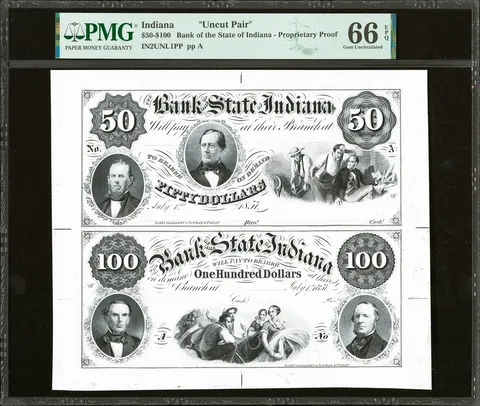 1857 Indiana $50-$100 Bank of the State Uncut Proof Pair PMG 66 EPQ Gem Uncirculated RareSee current price →